
The summer of 2026: not a weather event, but an operational risk
Corporate alliance urges the German federal government to take action in its appeal ‘Climate protection is location policy’
28 companies are calling on the Federal Government in a joint appeal to make corrections to energy and climate policy. The signatories include companies from the mechanical engineering and manufacturing sectors, banks, agriculture, engineering, consulting and service companies, as well as energy suppliers and developers of renewable energy projects. The impetus for the initiative is the recent hot, drought-stricken summer, which reduced yields, slowed workflows and limited the performance of technical installations. According to the Robert Koch Institute, it also cost the lives of around 16,000 people in Germany. In addition to the economic damage, there are operational losses: significant crop failures in agriculture, transport problems caused by restrictions on inland shipping, and more difficult cooling of technical installations. ‘The summer of 2026,’ the signatories of the appeal said, ‘was not a weather event for many companies, employers and employees, but an operational risk.’
“Heat and drought are probably affecting agriculture most obviously. ‘Water has become the key issue for us this summer,’ says Florian Reyer, farm manager for vegetable growing and renewable energies at the Heggelbach farm community, summing up the problem. ‘Due to the exceptionally long period of heat and dryness, we have seen major losses in yield and quality in our summer crops such as potatoes and vegetables; the lack of water has also led to a severe shortage of animal feed for us, and in some other farms even to an acute feed crisis. Anyone who has experienced that once understands why precaution is not a political option, but an economic necessity.’
However, the effects of climate change are now long since evident not only in agriculture, but in many sectors of industry and commerce as well — and very concretely in day-to-day operations. ‘Even in northern Germany, on particularly hot days we had to introduce additional protective measures for our employees and adjust work processes,’ reports Katharina Beyer, member of the executive board of Prokon Regenerative Energien eG. ‘There were health impairments, which directly reduces productivity. Anyone speaking about the competitiveness of companies must therefore also speak about climate protection and climate adaptation.’”
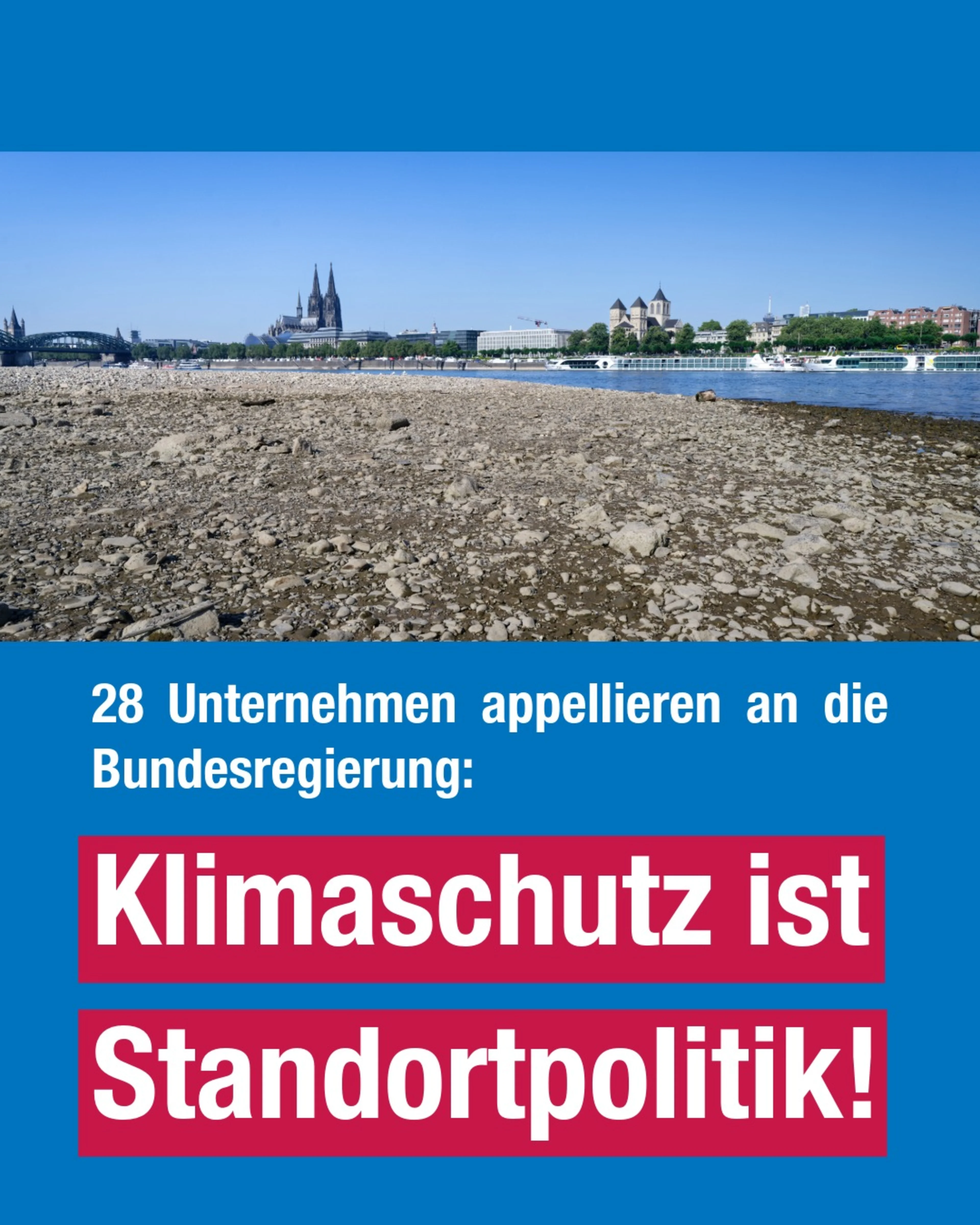
For these and many other reasons, the signatory companies are pressing for a change in political course. “The summer of 2026 brought Germany extreme heat, drought, low water levels and more hot days than ever before. And instead of responding to that, the federal government is scaling back climate protection instruments,” criticises Alexander Sladek, board member of EWS Schönau eG, and calls for greater determination: “Anyone who hesitates today is shifting the costs to tomorrow, to our businesses and to the next generation. As a cooperative, we know from experience that where a community acts decisively, things start to move.”
The companies that produce, supply, employ and invest in Germany are above all criticising the lack of reliability in the political framework. Key instruments of an innovative economic policy geared towards emissions reductions have, according to the appeal, been weakened: “From 2027, funds from the Climate and Transformation Fund (KTF) are to flow into the core federal budget, the CO₂ pricing path for 2027 is to be weakened or frozen, and the EEG amendment and the grid package bring new reservations when it comes to connecting renewable energy to the grid.” For companies planning on timescales of ten years or more, this removes the basis for calculations. The consequences reach as far as financing. Because banks must take climate risks into account in their ratings, political uncertainty has an immediate impact on access to capital, as the signatory GLS Bank points out.
“Today, it is being decided where the industrial value creation of the future will take place. We build machines in Germany and compete globally. Anyone who wants to strengthen Germany as an industrial location must give companies reliable conditions and a direction that does not change with political majorities. Climate policy is economic future security. That is why it belongs as a joint task, bindingly, in the Basic Law,” says Alrun Ohrmann, Managing Partner of OHRMANN GmbH.
At the same time, the companies set out a positive counter-image: “We see an industrial country that increasingly generates its own energy, retains its value creation in the country and becomes less dependent on imports. This path has begun, it is affordable, and it creates innovation and jobs.” The appeal explicitly supports the demands of other initiatives, such as those from civil society organisations for a heat summit and binding precautionary measures, or from mayors who want to see the energy transition understood more strongly as municipal economic policy. So far, it has mainly been organisations, local authorities and associations that have commented on the consequences of this summer. With this appeal, companies are now also speaking out—companies that feel the effects of climate change in everyday life and that are investing in the transition to a climate-resilient economy.
The companies add four points to their appeal: first, a reliable and ambitious CO₂ price. The revenues should be returned to households and businesses through a reduction in electricity tax or through funding programmes. Second, the investment use of the funds from the Climate and Transformation Fund. They belong in climate protection and transformation, not in the general budget. Third, a binding roadmap towards a fully renewable energy supply. “This includes rapid grid expansion and, above all, conditions under which investment actually pays off.” Fourth, finally, the inclusion of climate protection, climate adaptation and nature conservation as a joint task under Article 91a of the Basic Law.
About the appeal
“Climate protection is location policy” is an appeal from 28 companies to the Federal Government and the members of the German Bundestag. It was initiated by EWS Elektrizitätswerke Schönau together with Green Planet Energy, naturstrom and Bürgerwerke. The full text and the list of signatories can be found at https://ews.jetzt/appell. On 8 October 2026, the appeal was submitted to the Committee on Economic Affairs and Energy of the German Bundestag.