Charge your electric car with 100% renewable electricity from our own wind farms.
With our charging electricity tariff, you get power that comes 100% from our own wind turbines. So you not only charge your electric car with electricity from renewable energy sources, you also save real money: controllable wallboxes are subject to reduced network charges.

Use our tariff calculator to find the tariff that suits you best!


Green electricity directly from the producer
From our own wind farms across Germany.
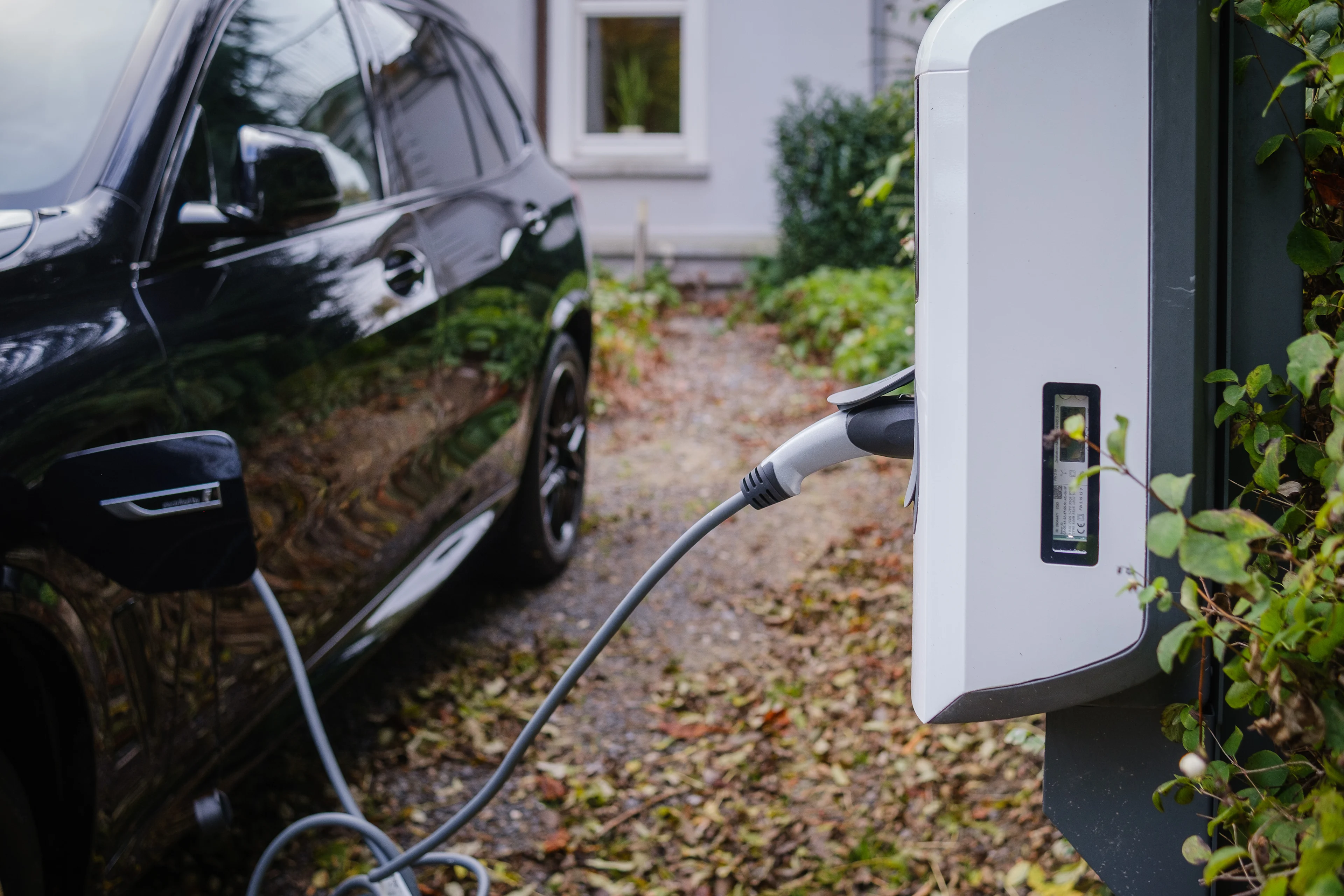
If you drive an electric car and have a home wallbox, you should definitely think about a charging electricity tariff. This way, with your electric car you not only produce less greenhouse gas emissions compared with a petrol or diesel car, but also save money – because controllable wallboxes are subject to lower grid fees. We pass this advantage on to you with our charging electricity tariff.
So that your electric car really does charge consistently with renewable energy at your wallbox, you need an electricity contract with 100% green power. That is exactly what we offer you: our special charging electricity tariff gives you energy that comes 100% from our own wind farms. We invest the proceeds in the further expansion of renewable energies.
According to Section 14a of the German Energy Industry Act (EnWG), reduced grid fees apply to wallboxes. What this specifically means for you, your charging electricity tariff and your wallbox is summarised in our FAQ.
Which tariff is right for you depends on various factors, for example whether the charging electricity is measured via a separate meter or what reduction you have agreed with your grid operator. Our tariff calculator helps you find the tariff that suits you and your wallbox.
If you still have any questions about grid-friendly control, you can find all the important information in our FAQ.

A charging electricity tariff is a special electricity tariff for buildings with wallboxes for charging electric cars. These tariffs are often cheaper than standard electricity because reduced grid charges apply to wallboxes. We pass this reduced grid charge on to you with our charging electricity tariff.
No. Since 01/01/2024, you can receive a reduced grid fee even without a separate meter, provided there is a corresponding agreement with your grid operator for grid-oriented control in accordance with § 14a EnWG. However, there are reductions that require a dedicated meter for charging electricity consumption.
You can find more information in our FAQ on § 14a EnWG.
Under Section 14a of the Energy Industry Act (EnWG), you, as the owner of a wallbox, can receive reduced grid fees. With our charging electricity tariff, we pass on these reduced grid fees to you. As a result, charging electricity is often cheaper than regular household electricity.
To qualify, your wallbox must be controllable – meaning it must be set up in such a way that your grid operator can temporarily reduce its output in rare cases to help stabilise the power grid.
You are free to choose your electricity supplier – there are therefore various tariffs available for charging electricity. However, your agreement with your grid operator determines which reduction in grid fees your electricity supplier can pass on to you.
You can find more information about this in our FAQ on § 14a EnWG.
An electric car can also be charged using a standard household electricity tariff. Special charging tariffs are cheaper.
It depends on the individual technical requirements. If you do not have a separate meter, Windstrom Mobil Kombi is a suitable option. You receive a possible reduction under Section 14a of the German Energy Industry Act (EnWG) and Module 1. If you use a second, separate meter for the charging electricity, you can choose between Prokon Windstrom Mobil Klassik and Prokon Windstrom Mobil Solo. Here too, the technical requirements must be met, and the relevant module under Section 14a EnWG must have been agreed with the grid operator.
At a rapid charging station, the charging power for electric cars is usually between 300 and 400 kW. A domestic wallbox has a standard charging power of 11 kW. Wallboxes of up to 22 kW are also available. At an 11 kW wallbox, an electric car takes around 4 to 5 hours to charge. For an 11 kW wallbox, notification to the grid operator is sufficient. A 22 kW wallbox must be approved by the grid operator and installed by a qualified electrical contractor.
The charging price for an electric car depends on where you charge your EV. The cheapest option is to charge your EV at home using a wallbox. Household electricity can be used for this, but special charging tariffs such as our Windstrom Mobil tariffs are even cheaper. Thanks to reduced grid fees, the charging electricity is cheaper than the household electricity tariff. The cheapest option is to use the electricity you generate yourself from a photovoltaic system. It becomes expensive when you charge your EV at rapid charging stations. There, the charging price is usually between 40 and 80 cents per kWh.
The price of charging an electric car depends on various factors:
the size of the battery (e.g. 40, 60 or 80 kWh);
the electricity tariff selected — here we recommend our Windstrom Mobil tariff;
how full or empty the battery is at the time of charging.
An example given is an electric car with a 60 kWh battery. If it is charged fully at a price of 30 cents/kWh, a complete charge costs a total of 18 euros. With a fully charged 60 kWh battery, a range of between 300 and 400 kilometres is possible, depending on driving style and the time of year.